Iris Walter · 22 September 2026
How Tree Architecture Shapes Sunfleck Patterns and Supports Rare Plant Growth in Protected Alpine Valleys
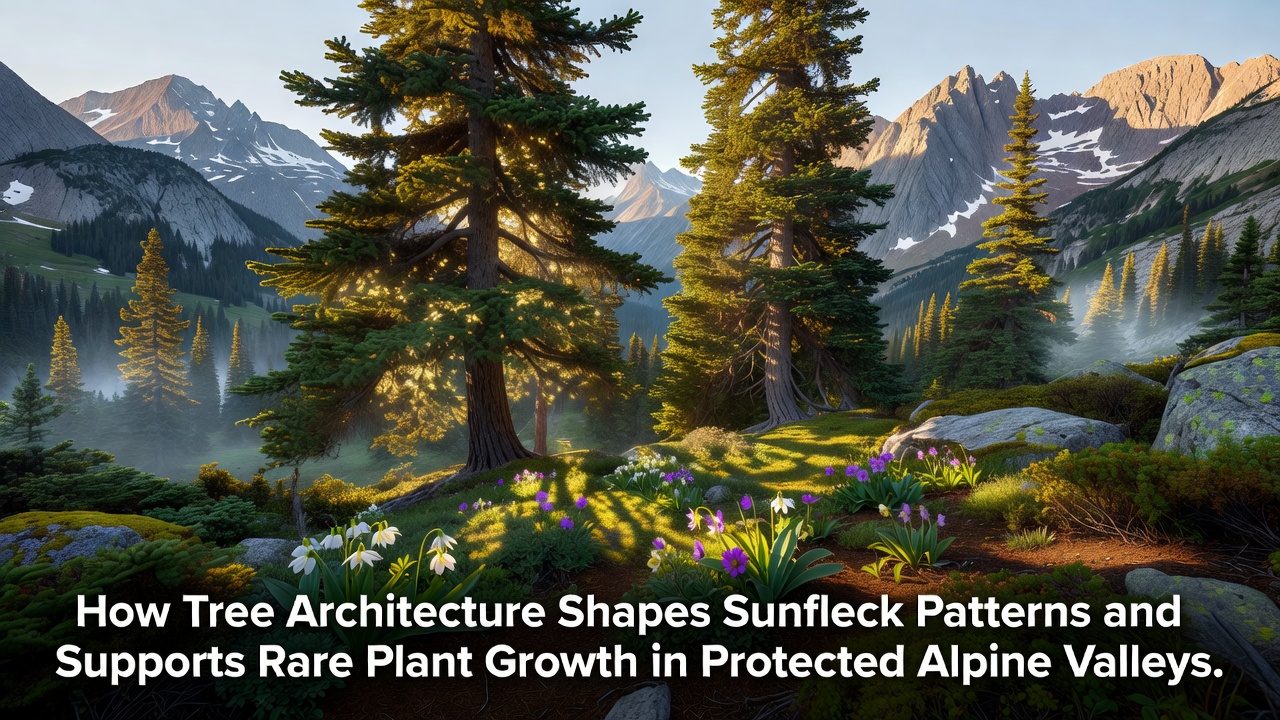
Tree architecture in protected alpine valleys determines how sunlight reaches the understory through gaps in the canopy, and researchers have documented these effects across multiple sites in the European Alps. Branches, leaf angles, and crown shapes control the size, duration, and intensity of sunflecks that move across the ground as the sun tracks across the sky. In valleys such as those in the Valais region, species like Norway spruce and European larch produce different light regimes because their branching patterns create either dense, overlapping layers or more open, irregular gaps.
Studies show that sunflecks contribute between 40 and 60 percent of daily photosynthetic carbon gain for many understory species even though they occupy only a small fraction of total daylight hours. Data collected in September 2026 from monitoring stations in the Valais region showed that valleys with mixed-age stands of larch and stone pine recorded higher numbers of short-duration sunflecks than pure spruce stands of similar density. The difference arises because larch crowns shed needles seasonally and maintain more spaced primary branches, allowing brief shafts of light to penetrate at varying angles throughout the day.
Canopy Structure and Light Penetration Mechanics
Observers note that crown depth, branch spacing, and leaf clumping directly influence sunfleck frequency and size. Tall, narrow crowns typical of high-elevation conifers produce smaller, more numerous flecks that travel quickly across the forest floor, while broader, flatter crowns generate larger patches that linger longer in one location. Researchers at several alpine field stations have measured these variables using arrays of quantum sensors placed at ground level and at different heights within the canopy. Results indicate that a 10 percent increase in branch clumping can reduce sunfleck duration by up to 25 percent in mid-summer conditions.
Protected areas limit logging and development, which preserves natural variation in tree architecture across elevation gradients. In these settings, older stands often contain individuals with broken tops or asymmetric crowns caused by wind and snow load, and such irregularities create additional light pathways that younger, uniform stands lack. Monitoring programs record higher understory plant diversity in locations where these natural crown deformities occur.
Sunfleck Effects on Rare Understory Species
Rare plants adapted to alpine valley floors frequently depend on the brief high-intensity light provided by sunflecks for reproduction and growth. Species such as certain orchids and cushion-forming herbs show increased flowering rates in microsites that receive several sunflecks per hour during the growing season. Continuous shade from dense canopies suppresses these plants because their photosynthetic machinery activates efficiently only during short bursts of direct light. Field measurements demonstrate that plants positioned under more open larch canopies accumulate measurable biomass gains during peak sunfleck periods compared with those under closed spruce canopies.

Long-term plots established in protected valleys reveal that changes in tree architecture over decades correlate with shifts in plant community composition. When wind or snow damage opens the canopy of individual mature trees, new sunfleck pathways appear and previously suppressed species increase in cover within two to three growing seasons. Conversely, dense regeneration beneath gaps can close those pathways again, returning the understory to lower light levels. Data from repeated surveys indicate these cycles maintain habitat heterogeneity essential for maintaining populations of light-sensitive rare species.
Measurement Methods and Regional Observations
Scientists deploy hemispherical photography, light sensors, and three-dimensional canopy mapping to quantify how specific architectural traits translate into sunfleck patterns. These techniques allow comparison across valleys with different dominant tree species and management histories. In September 2026, updated sensor networks in several protected sites provided finer temporal resolution, confirming that sunfleck frequency peaks in late morning and early afternoon when solar angles align with prevailing branch orientations. Regional differences appear clearly between western and eastern alpine valleys because prevailing wind directions shape crown asymmetry differently in each area.
One study from the Swiss Federal Institute for Forest, Snow and Landscape Research examined crown traits across elevation gradients and found consistent relationships between branch angle distribution and ground-level light variability. Complementary work from North American alpine sites, including data released by the U.S. Geological Survey, shows similar patterns in subalpine fir and Engelmann spruce stands, confirming that architectural principles operate across continents despite differences in species composition.
Conclusion
Tree architecture therefore functions as a primary driver of sunfleck dynamics that in turn support populations of rare plants within protected alpine valleys. Ongoing sensor deployments and repeated vegetation surveys continue to document how crown traits, stand age, and topographic position interact to produce the light environments these species require. The relationships established through field measurements provide baseline information for understanding how future changes in forest structure may affect understory communities in these protected landscapes.